How to Describe Your D&D Character to an Artist (Without Writing a Novel)
How to Describe Your D&D Character to an Artist (Without Writing a Novel)
A studio insider's system for writing a commission brief that actually gets you the portrait you're picturing — face-first, references annotated, mood named out loud.
Most commissions don't miss the mark because the artist had a bad day. They miss because the brief described the character the way a friend would describe a movie they liked — vague mood, no specifics, three adjectives doing the work of thirty. The artist needs specifics.
We've read every kind of brief at this point — three-line one-paragraph things from players who knew exactly what they wanted, and ten-page Google Docs that somehow described nothing. Length isn't what makes a brief good. Specificity is. After roughly 400 character commissions through our order form, we can tell within the first two paragraphs whether a brief is going to translate cleanly to the screen or whether we'll be sending three rounds of "can you clarify?" messages before sketch phase.
This is the brief-writing system we wish every client used. It takes about 15 minutes to write a good one. Save yourself a revision round — work through these sections in order, and your finished piece will look like the character you've been carrying around in your head for the last six months of your campaign.
Start with the bones — name, species, class, ancestry
Before you describe a single freckle, give the artist the four facts that constrain everything else. Name, species (or ancestry), class, and a one-sentence read on where the character comes from. These four lines set the silhouette before any line decision happens.
Why this matters: a half-orc barbarian and a tiefling sorcerer have entirely different default proportions, head shapes, hand sizes, and weight distribution. The species and class tell the artist what skeleton to draw under everything else. If you skip this and jump straight to "she has a scar over her left eye," the artist has to guess whether "she" is 5'2" and elven-light or 6'4" and built like a goliath.
Write it as a header block at the top of your brief, like a character sheet stat block:
- Name: Vex Tallowmire
- Species: Half-elf (human father, wood elf mother)
- Class: Rogue (Arcane Trickster), level 7
- Origin: Grew up in a port city, ran with a smuggling crew, now reformed-ish
Four lines. That's it. The artist now knows the proportions, the silhouette, the typical color palette of the world she walks through. Everything else stacks on top of this foundation. Clients who skip the bones and lead with "she's mysterious" send us into round-two revisions about 80% of the time.
Describe the face first, in this order
Face-first beats head-to-toe because in 9 out of 10 commissions, the face carries the likeness. Bust crops, half-body, full-body — the viewer's eye lands on the face within the first half-second. Get the face right and the rest follows.
Use this order:
- Age. Not "young" — give us a number. "Late 20s." "Looks 16 but is 140." Age changes everything about how we render eyes, mouth corners, neck, hands.
- Build. Wiry? Soft? Heavy through the shoulders? Tall and reedy? One sentence.
- Ethnicity or heritage. Be direct. "Black, dark brown skin, broad nose." "East Asian features, warm undertone." "Sun-weathered Mediterranean." This isn't impolite — it's the most useful single sentence in the whole brief. Vague heritage gets you a generic anime-default face.
- Distinguishing features. Scars (where, how long, how old), freckles (cheeks? bridge of nose? full dusting?), eye shape, jaw, lips, ears, teeth if relevant.
Example: "Late 30s, tired around the eyes. Wiry build, all forearms. Black, deep brown skin, shaved head. Long thin scar from right temple down past the jawline — old, faded. Heavy brows, broad mouth, slight gap in the front teeth when she smiles."
That's 45 words. The artist now has a face. Compare that to "she's a cool warrior woman with scars." We get one of those briefs every week and they always come back for revisions.
Then the expression — what mood are we capturing?
Most briefs forget this step entirely and it's the single biggest predictor of a revision request. "Just a portrait" is not a mood. The artist will default to "looking at camera, neutral expression" and then you'll see it and realize that's not what you wanted at all.
Pick a moment from the campaign. Tell us what your character is doing in their head right now, in the painting. Are we catching them:
- Calm and watchful, scanning a tavern for the face they came to find?
- Mid-laugh at a joke their bard just told?
- End-of-battle exhaustion, blood not theirs on their chin, breath still ragged?
- Cold-eyed in court, about to lie to a duke?
- Quiet pride, holding up a holy symbol they just earned?
Each of those is a completely different painting. Different brow position, different mouth, different shoulder tension, different lighting energy. "End-of-battle exhaustion" tells the artist to drop the shoulders, soften the eyes, add shine to the lower lip, push warm color into the cheeks. "Cold-eyed in court" tightens everything.
One sentence is enough. "I want her right after she's killed someone important to her — not crying, not stoic, but somewhere in the seam between." That's a paintable sentence. Read more on framing emotional moments in our how to commission D&D character art guide.
Then the outfit, gear, and signature props
Now we get to the fun part — the stuff the character wears and carries. The mistake here is trying to describe everything. Your character probably has 30 items on their sheet. The portrait will show 5 to 8 of them, tops.
Pick two or three signature items and describe those in real detail. Everything else gets a category-level mention.
What we need:
- Armor or clothing — type and color. "Studded leather, oxblood and black, worn over a cream linen shirt." Not "armor." Not "fantasy clothes."
- Weapons — what and how they're carried. "Two daggers, one on each hip, handles facing forward for cross-draw. A hand crossbow holstered under the left arm." Carry position matters as much as the weapon itself.
- One or two signature items. A holy symbol, a spell focus, a piece of jewelry from a dead mentor, a journal she always carries, a single earring her brother had a match to. These are the story-anchors that make the portrait feel like your character and not a generic class illustration.
- What to skip. Belt pouches, rations, rope, the contents of a backpack. The artist will hint at gear with shapes and shadows. Don't list every coin.
The signature item is the one most clients underdescribe. "She has a holy symbol" is six words; "a sun symbol stamped into a copper disc, hammered flat, worn on a leather thong, the edges blackened from a fire she barely escaped" is a paintable detail you'll see and recognize the second you open the file. Order form has a dedicated field for this — see the structure at /order.
Pose and framing — say it plainly
Tell us the crop. Plainly. In one of three words: bust, half-body, or full-body. Then tell us the angle: three-quarter, straight-on, or profile. Then tell us the energy: action or neutral.
That's three sentences and it eliminates 70% of pose-related revision requests.
- Bust: chest-up. Best for facial likeness, expression, jewelry, hair.
- Half-body: mid-thigh up. Shows weapons drawn, hand gestures, the top half of an outfit.
- Full-body: head to feet. Best for armor, silhouette, stance. Loses face detail.
A worked example: "Half-body, three-quarter angle (left shoulder forward), neutral pose — she's leaning one shoulder against a doorframe, arms crossed, looking at the viewer. Not action." That's 30 words. The artist now knows the camera position, the body language, and the energy. Bonus points if you say which hand is doing what — "right hand resting on dagger hilt, left thumb hooked in her belt" is gold.
If you genuinely don't know what crop you want, default to half-body, three-quarter, neutral. It's the most flattering combination for character portraits and it's what we'll recommend if you ask. Full pricing tiers by crop are on our process page.
How to write about reference images
Send 3 to 5 reference images. Not 50. We have politely closed Pinterest boards with 80+ pins on them — that's not a brief, that's a research project, and we will end up guessing which 5 you actually meant.
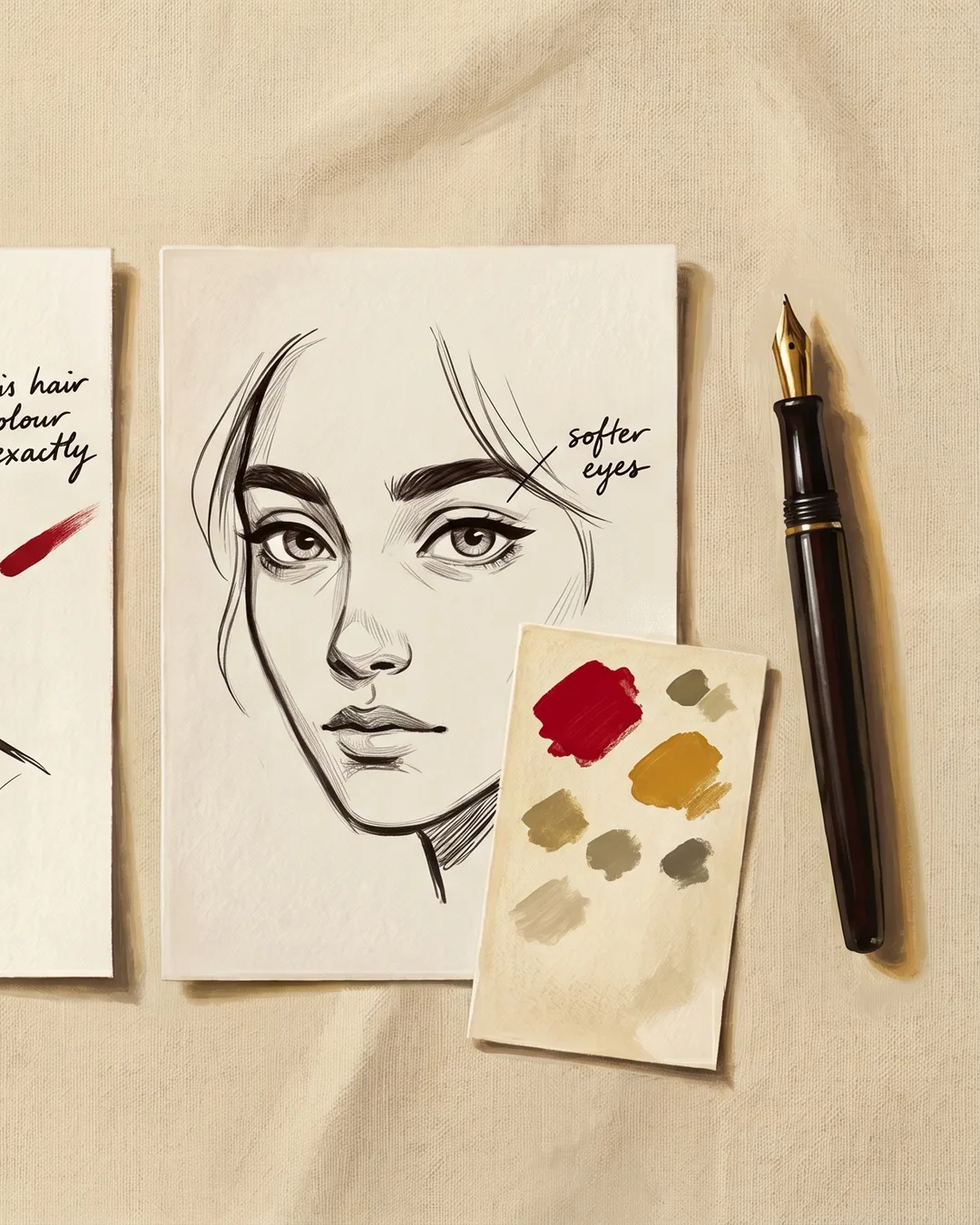
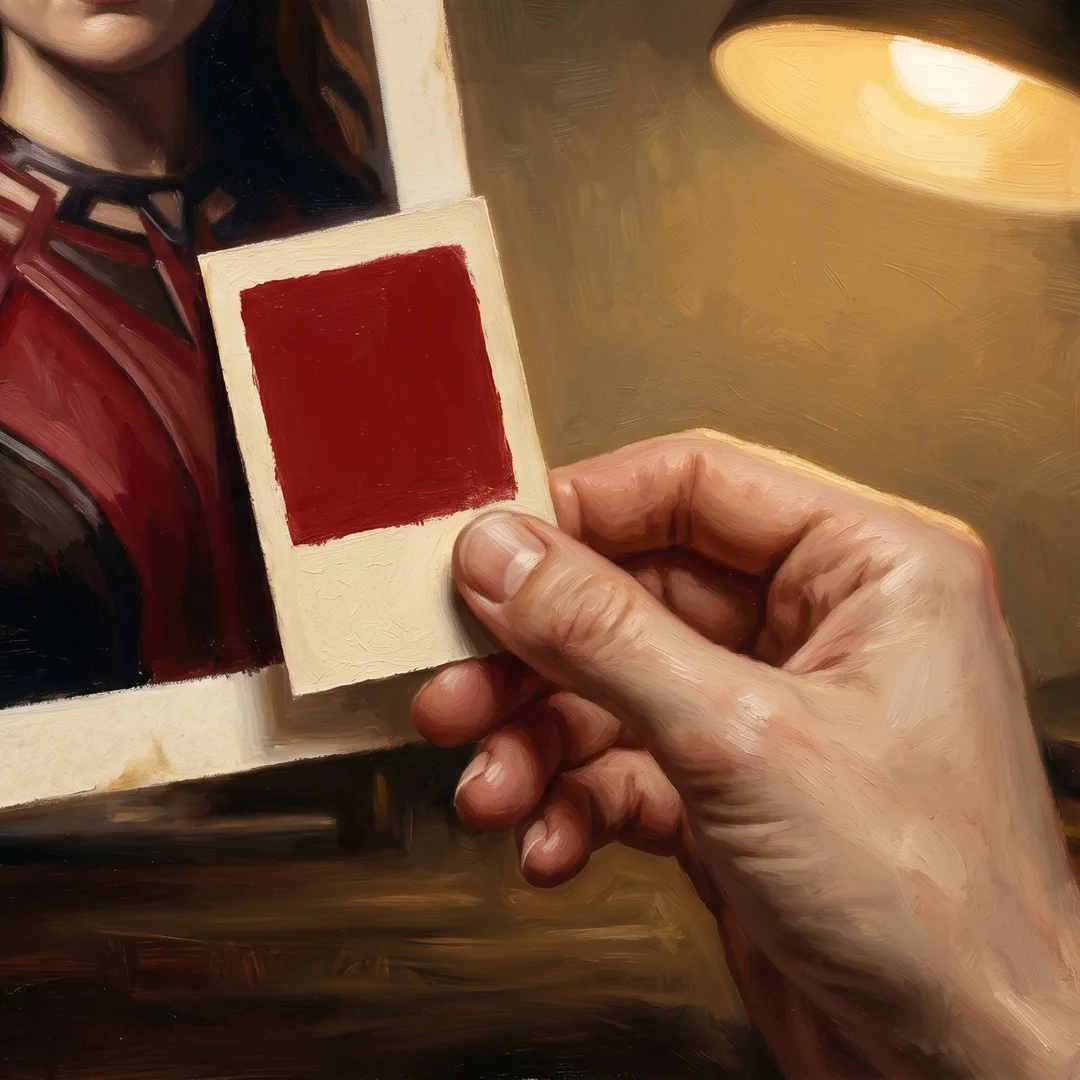
The single most important rule about references: annotate every one. For each image, write one sentence telling the artist what to take from this reference.
- "This one for face shape and freckle pattern."
- "This for the armor color palette only — ignore the pose."
- "This for the pose and shoulder tension."
- "This for the lighting mood — warm key, cool rim."
- "This for the hair texture and length."
Unannotated piles of references are worse than no references at all, because the artist has to guess what you liked about each one, and they'll guess wrong about half the time. A reference with no note attached is just a confusing signal.
Two more reference rules:
- Don't send conflicting refs without flagging the conflict. If you send three faces and they don't look alike, tell us which one is closest and what to pull from the other two.
- No AI-generated images as references. We'll politely refuse them. AI references encode AI-generated anatomy mistakes that we then have to "translate" out of the painting, and the result drifts away from your character. Real photos, real artwork, screenshots from games — all great. Midjourney outputs — no.
Use comparison language: more like X, less like Y
The most useful sentence pattern in any commission brief is the polarity: "More like [A], less like [B]." Polarities beat absolutes because they tell the artist not just what you want, but the gradient you want to move along.
"Make her serious" is an absolute. The artist doesn't know how far to push it. Is she stoic? Is she grim? Is she sad? "More like the cold-eyed watchfulness in the second reference, less like the dramatic scowl in the first" tells the artist exactly where to land on the dial.
Use this pattern for every dimension you care about:
- Build: "More like a swimmer, less like a bodybuilder."
- Vibe: "More like a librarian who knows how to fight, less like a soldier in a library."
- Color palette: "More like sunset, less like neon."
- Energy: "More like dangerous-calm, less like angry."
- Hair: "More like a hand combed through it three hours ago, less like a salon."
Three or four polarities in a brief will save you a revision round, easy. They give the artist the direction of your taste, which is harder to communicate than the destination.
What NOT to write in your brief
A short clear list of things that almost always cause problems:
- Vague modifiers. "Cool," "epic," "badass," "sick," "awesome." These describe how you'll feel looking at it, not what's in the image. Cut them all.
- Conflicting references with no priority order. If your refs disagree, you have to tell us which one wins.
- Last-minute additions in the third email. "Oh, also she has a familiar — a raven." That's a re-paint, not a revision. All key elements go in the original brief.
- AI-generated images as references. Mentioned above, repeated here because it comes up most weeks. We will ask you to swap them.
- "Surprise me." This sounds generous and it isn't. It puts the entire creative weight on the artist with no anchor, and the result is statistically less likely to feel like your character.
- Pricing and turnaround inside the brief. Those live on the order form and the process page. Keep the brief about the character.
If you're unsure whether something belongs in the brief, our FAQ covers most of the edge cases — refund timing, revision rounds, what file formats we deliver.
Sample brief template
Here's a copyable markdown template. Fill in the bracketed parts. This is genuinely all you need — the briefs we love most are usually 300 to 500 words long.
## The Bones
- Name: [Character name]
- Species/ancestry: [e.g. Half-elf, human father wood-elf mother]
- Class: [e.g. Rogue, Arcane Trickster, level 7]
- Origin (1 sentence): [Where they're from, what they do]

## Face
- Age: [Real number, e.g. "late 20s"]
- Build: [One sentence]
- Heritage/ethnicity: [Direct description, skin tone, features]
- Distinguishing features: [Scars, freckles, eye shape, anything specific]

## Expression / Mood
[One sentence naming the moment in the campaign we're catching.]

## Outfit, Gear, Signature Items
- Armor/clothing: [Type and colors]
- Weapons: [What, and how carried]
- Signature item 1: [Detailed description]
- Signature item 2: [Detailed description]

## Pose and Framing
- Crop: [Bust / half-body / full-body]
- Angle: [Three-quarter / straight-on / profile]
- Energy: [Action / neutral]
- Body language: [One sentence]

## References (3-5, each annotated)
1. [link] — for [what to take from it]
2. [link] — for [what to take from it]
3. [link] — for [what to take from it]

## Polarities (3+)
- More like [A], less like [B]
- More like [A], less like [B]
- More like [A], less like [B]

## Anything else (max 2 sentences)
[Optional context — a memorable campaign moment, a personality note, a one-line backstory beat.]
That's it. Copy it, paste it into the order form's brief field, and fill it in. Briefs in this format get to sketch phase about 40% faster than free-form briefs of the same length. More examples in our companion piece on how to write a commission brief.
Ready to brief your commission?
Our order form is structured around exactly this template — we'll walk you through the bones, the face, the mood, and the references in order. Take a look at the portfolio first if you want a sense of what we'll do with a strong brief, and read the process page for what happens after submission. Most clients write their brief in one sitting, sleep on it, edit it once, and submit. That's all it takes.