D&D Character Art: AI vs Commissioned vs Hand-Painted — An Honest Three-Way Guide
D&D Character Art: AI vs Commissioned vs Hand-Painted — An Honest Three-Way Guide
A working studio's honest comparison of AI-generated, AI-assisted, and fully hand-painted D&D character art — what each one actually is, what it costs, and how to tell them apart before you spend a dollar.
Intro
If you've looked at D&D character art lately, you've probably noticed three things: AI generators are everywhere, real artists are pushing back, and the line between them is getting harder to spot. A piece that looked like an obvious Midjourney output two years ago now arrives on Fiverr labeled "custom commission" with a $40 price tag and a watermark. The reverse is also true — some of the strongest hand-painted portraits we see online are dismissed in the comments as "probably AI" because the painter happens to be good at clean rendering.
The line is blurry because the market wants it blurry. Sellers who use AI as a base benefit from being read as traditional artists. Generator companies benefit from their outputs being mistaken for handwork. The person who loses is the player who paid $80 thinking they were getting one thing and got another.
We've delivered 200+ hand-painted commissions since 2024 from a small studio run by one painter, Hector G. We work without AI. We've also watched the AI economy reshape what "commission" means in our category. This article is the honest three-way comparison we wish existed when clients first reach out asking what they're actually choosing between. It's not a manifesto against AI. It's a guide to telling the three categories apart, knowing what each gives you, and choosing the right option for the use case in front of you.
The short version: AI is real, AI-assisted commissions are real, hand-painted commissions are real, and they are not the same product. You can see the differences in the work, in the price, and in the rights you walk away with. Here's how to spot them.
The three categories of D&D character art today
There are three categories of art being sold to D&D players right now, and the boundaries between them matter more than most marketplaces admit.
AI-generated. Pure machine output from a generator like Midjourney, Stable Diffusion, Niji, or Imagen. The user types a prompt, optionally feeds a reference image, the model produces a result, and the result is sold or used as-is. Cost: $0 if you use a free tier, $10–30/month for a paid subscription, $60+/year for ongoing access. No human painter is involved in the rendering — the model does the work and the prompt-writer curates outputs. This is the cheapest, fastest option. Turnaround is measured in seconds.
AI-traced or AI-assisted. A human "paints over," "finishes," or "fixes" an AI-generated base. This is increasingly common on Fiverr ($20–80 per piece), Etsy ($30–100), and on Discord-based art servers that don't require disclosure. The seller generates a base image in a tool, imports it into Photoshop or Procreate, paints over the obvious tells (hands, eyes, weapon hilts, armor seams), and delivers the result as a "custom commission." Some sellers disclose this. Many don't. The work can look strong at thumbnail size and falls apart on close inspection — we'll show you exactly what to look for in a later section. Turnaround is usually 24–72 hours for the seller because the base is generated in seconds; the human time is in the paintover.
Fully hand-painted. A human paints from scratch, working from your written brief and your reference images. No AI is involved in the workflow — not for the sketch, not for color blocking, not for cleanup. The artist makes every brush stroke decision. We work this way. Cost in our shop runs $60 (bust starter) to $900+ (full action scene with environment). Turnaround at our studio is 2–4 weeks depending on the queue. We can show layered PSD files, timestamped progress shots, and live sketch sessions on request.
These three categories produce three different products at three different price points with three different sets of rights. They are sold side by side on the same marketplaces under the same word — "commission" — which is why telling them apart matters.
Side-by-side: the same paladin, three ways
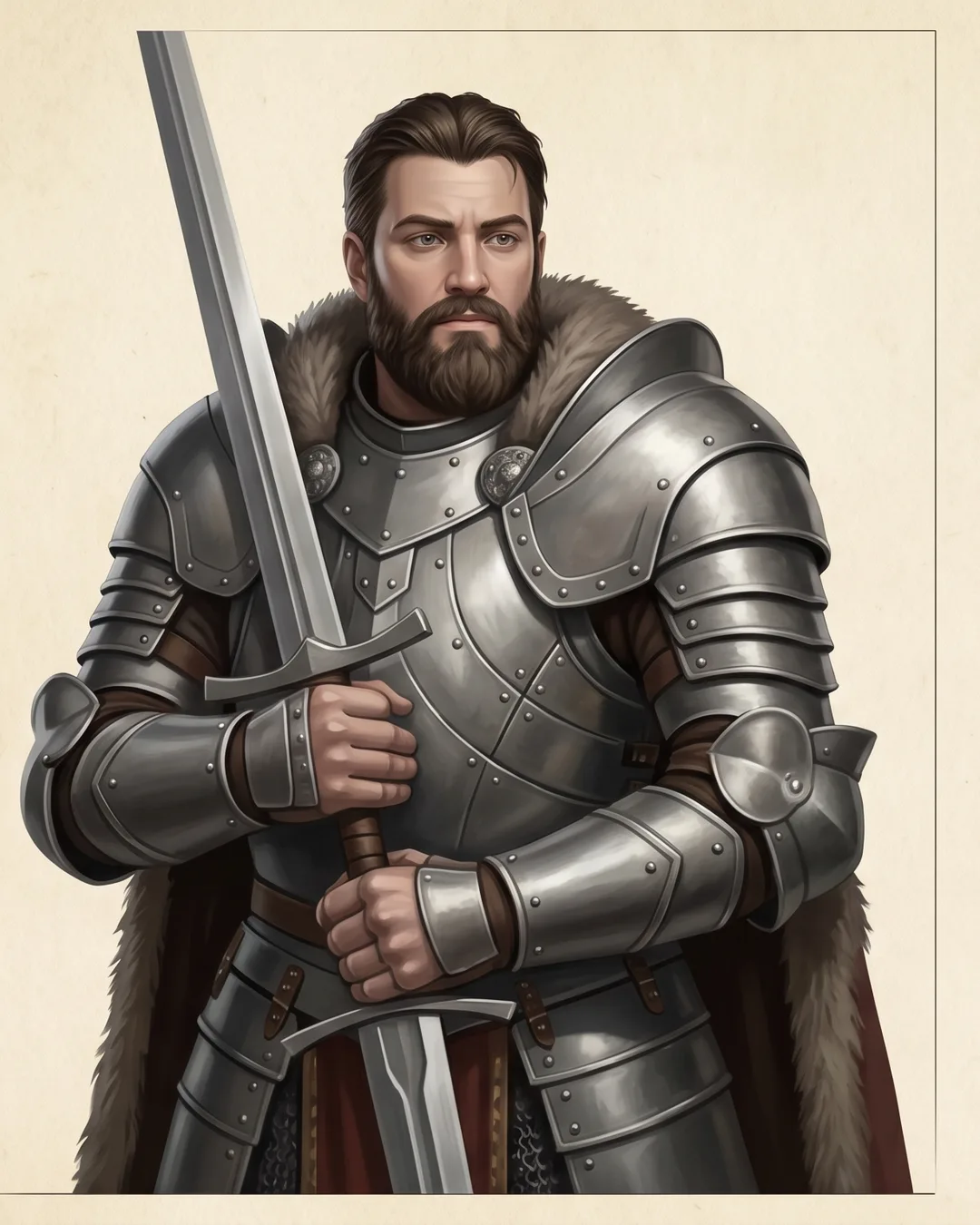
Imagine the same brief delivered to all three: a half-elf paladin of the Raven Queen, scarred face, gold-trimmed black plate, a longsword held point-down, somber daylight, three-quarter view from the chest up. Here's what you'd see in three side-by-side renderings.
The AI generation reads beautifully at thumbnail. Pull up close and the cracks show. The armor is over-rendered — every rivet competes for attention, every scratch has the same level of detail, and the gold trim flows in patterns that don't follow any actual armor logic. The hands, if they're visible, betray the model: six fingers, or four, or a thumb that joins the palm at the wrong angle. The eyes are subtly off — one focuses on the camera, the other looks an inch past it, because the model averaged a thousand reference faces and never aligned the focal plane. The face is generic-pretty. It could be anyone's half-elf paladin. It is, by averaging, no one's specifically.
The AI-traced "commission" looks more polished at first glance. The hands have been fixed — usually. The eyes are aligned. The most obvious tells are gone. Pull closer and a different problem appears: the paintover surface is inconsistent. The hands the painter fixed have visible brushwork; the chest armor the painter didn't touch still has the over-rendered, no-logic AI surface. The light source is sometimes wrong on parts the painter left alone. The longsword hilt has a pattern that doesn't repeat correctly. The face is still subtly an averaged face, because the painter didn't repaint the bone structure — they cleaned the surface. It's a hybrid object: AI in the base, human on the top coat, neither fully one thing nor the other.
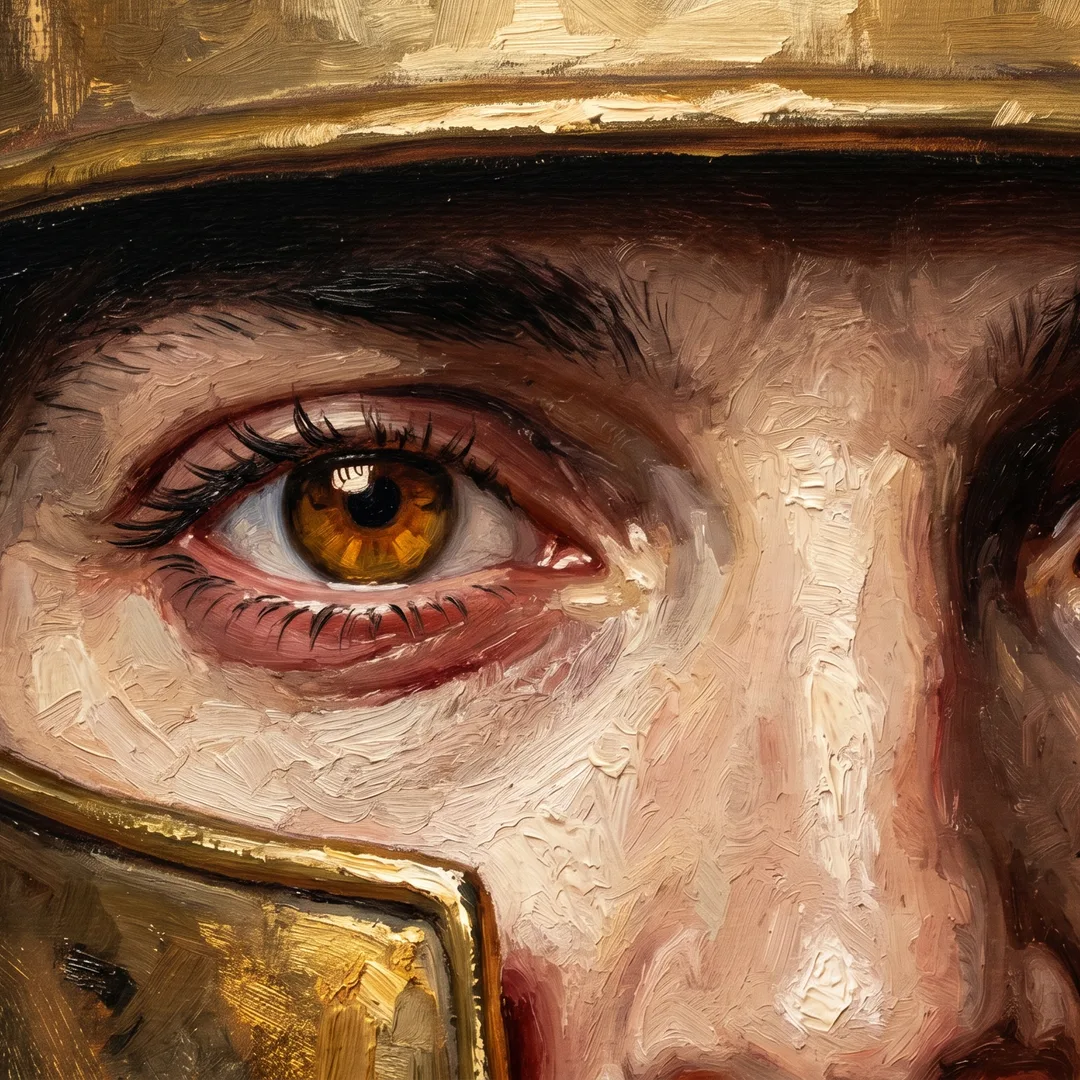
The fully hand-painted commission looks different from the first inspection. The brushwork is visible across the whole piece because one painter made every stroke. Five fingers on each hand, every time. The armor follows internal logic — the same number of rivets on each pauldron, the gold trim follows the actual seams of the plate, the scratches accumulate where a real fighter would scuff their gear. The eyes focus on the same plane because the painter decided where the paladin is looking and painted both eyes toward that point. The catchlights in the eyes match the somber daylight described in the brief — one light source, applied consistently across the whole portrait. The scar follows the bone structure of this specific face, not an averaged face. The expression is a choice — somber, weighted, alert — not a generated default.
The AI generation is an averaged face. The AI-traced commission is an averaged face with cleaner hands. The hand-painted commission is a specific face — yours.
You can see all three categories in our portfolio. The hand-painted work prints. The other two don't, at least not at the size people want to frame.
What hand-painted gives you that AI doesn't
This is the section where we get specific. We've done 200+ commissions since 2024. Here's what a hand-painted portrait gives you that an AI generation — or an AI-traced "commission" — does not.
Specific likeness. Your character, not an average of others. When a client sends a brief that says "her left eyebrow is split by a thin scar, her nose was broken once and healed crooked, she has a small mole below her right eye," the painter paints those three things. Exactly those. An AI model can be coaxed toward those features but cannot reproduce them with fidelity across versions, and the AI-traced workflow inherits the model's averaging. A hand-painted portrait is the character your player rolled, not the model's best guess at who they might be.
Pose, expression, narrative moment. Chosen, not generated. We've painted a tiefling warlock the moment after she lets a friend die because the pact required it — that piece is on a client's wall in Portland. We've painted a dwarven cleric mid-prayer, eyes closed, sword reversed point-down at his feet, on commission for a campaign that ran six years. These are specific narrative moments. A model can generate "a tiefling warlock looking sad" but it cannot generate the moment after, the weight of the choice in the shoulders, the eyes that are dry but should not be. The painter and the player decide that together during the brief.
Visible brushwork that prints and frames well. AI outputs at large print sizes show their tells. The over-rendered surface, the inconsistent light, the soft details — what reads as "lush" at 800px reads as "muddy" at 16x24 inches on a wall. Hand-painted work has brush direction and intentional texture variation; it survives the print process because it was made for it. Most of our commissions get printed and framed by the client; many include a hardcopy giclée print as part of the delivery.
The artist's hand — decisions a model can't make. A small detail in the iris that picks up the cloak color. A tiny chip in the gold trim on the side of the helm the camera barely sees. The way the breath fogs slightly in the cold scene. These are decisions a painter makes because they were thinking about the character while painting them. A model doesn't think. A paintover artist working from an AI base doesn't have the room or the budget to add these — the price point assumes minimal time per piece.
Commercial usage rights. This is the one most clients don't think about until they need it. The US Copyright Office, in its March 2023 guidance on AI-generated works, made clear that AI-generated content without sufficient human authorship is not protected by copyright. The implications: an AI-only image can't be exclusively yours. An AI-traced piece sits in a gray zone — the human contribution may or may not be enough. A fully hand-painted commission, with the painter's authorship documented, is unambiguously copyrightable, and our terms transfer the relevant rights to the client. If you want a portrait you can put on merch, a Kickstarter, a novel cover, or a podcast — only the third category gives you that cleanly. Our pricing page explains which rights come with which tier.
Internal consistency. Five fingers on each hand, the same number of armor rivets on each pauldron, eyes on the same focal plane, the same character in front and back views if you commission a turnaround, the same scar on the same side three years later if you come back for a second piece. We keep a working file. We can come back to a character. A model cannot.
A model paints an averaged guess. A painter paints a specific person. That is the entire product difference, and it is the reason the price is different.
You can read more about how we approach this in our sibling piece, hand-painted character art vs AI: a values manifesto, which goes deeper into the studio's reasoning.
What AI is actually good for in your D&D campaign
We're going to be honest here, because pretending AI has no real uses makes the rest of this article less believable. AI generators have a place in tabletop. We use them ourselves for some things.
Mood-board references. When you're trying to figure out what your character looks like before you commission them, generating 30 quick variations in Midjourney costs you 10 minutes and gives the painter something visual to point at. We accept AI-generated reference images in client briefs all the time. They're useful.
Visual exploration. "I think I want her in red, but maybe blue would feel more like her" — that's a $0 question if you generate four versions instead of asking the painter to do four palette studies.
Quick NPC fillers. If you're a DM running a session tomorrow and you need 10 disposable faces for a tavern scene, generating them is the right answer. The party is not framing them. Nobody is keeping them on their fridge. Use the tool that fits the job.
Brainstorming aesthetic. "What does necromancer-architecture look like" or "what would a fungal druid robe look like" — that's a generation problem, not a painting problem. Generate, screenshot, send the screenshots to the painter as part of the brief.
AI as a starting point for the painter to look at — fine. AI as the output the client receives — that's a different product.
What we don't do is use AI in the commission itself. We don't generate a base and paint over it. We don't import a Midjourney output into the working file. The line is: AI before the brief is a tool; AI inside the commission is a substitute. We use the first. We don't do the second.
How to tell if a "commission" is actually AI-assisted
Here is the practical part. If you're shopping right now and you want to know whether the artist in front of you is selling you a hand-painted piece or an AI-traced one, these are the signals.
Red flags in a portfolio.
- Volume that doesn't match the work shown. A solo artist posting 12+ "commissions" in a single week, every piece detailed enough to print, is almost certainly using AI as a base. A working hand-painter at the same detail level delivers 4–8 pieces a month. Look at the post timestamps on their gallery.
- Inconsistent rendering quality across pieces. Hands rendered too perfectly in some pieces and not at all (hidden behind capes, cropped out of frame) in others. This is a classic AI tell — the painter is cropping out areas the model botched.
- Eyes that don't track the same focal plane on close inspection. Zoom in. If the left iris focuses on one point and the right iris focuses on a slightly different point, you're looking at a model output. Hand-painted eyes are aligned to the same target because the painter chose where the character is looking.
- Inconsistent armor or jewelry logic. Different numbers of rivets, beads, or pattern repeats on left vs right sides. Patterns that don't make structural sense — gold trim that flows in directions plate armor doesn't actually seam.
- "Soft" details that fall apart when you zoom in. Chains that don't link, sword hilts whose grip wrapping isn't continuous, hair that fades into the background without strand logic. AI handles broad shape and surface well; it handles continuous small-scale logic poorly. Paintovers usually don't fix these.
- Faces that are subtly the same person across "different" characters. The model's averaging bias produces a recognizable face. If half the pieces in a portfolio share the same nose, the same eye spacing, and the same chin, the seller is probably reusing a generation style with paint on top.
Questions to ask any artist before commissioning.
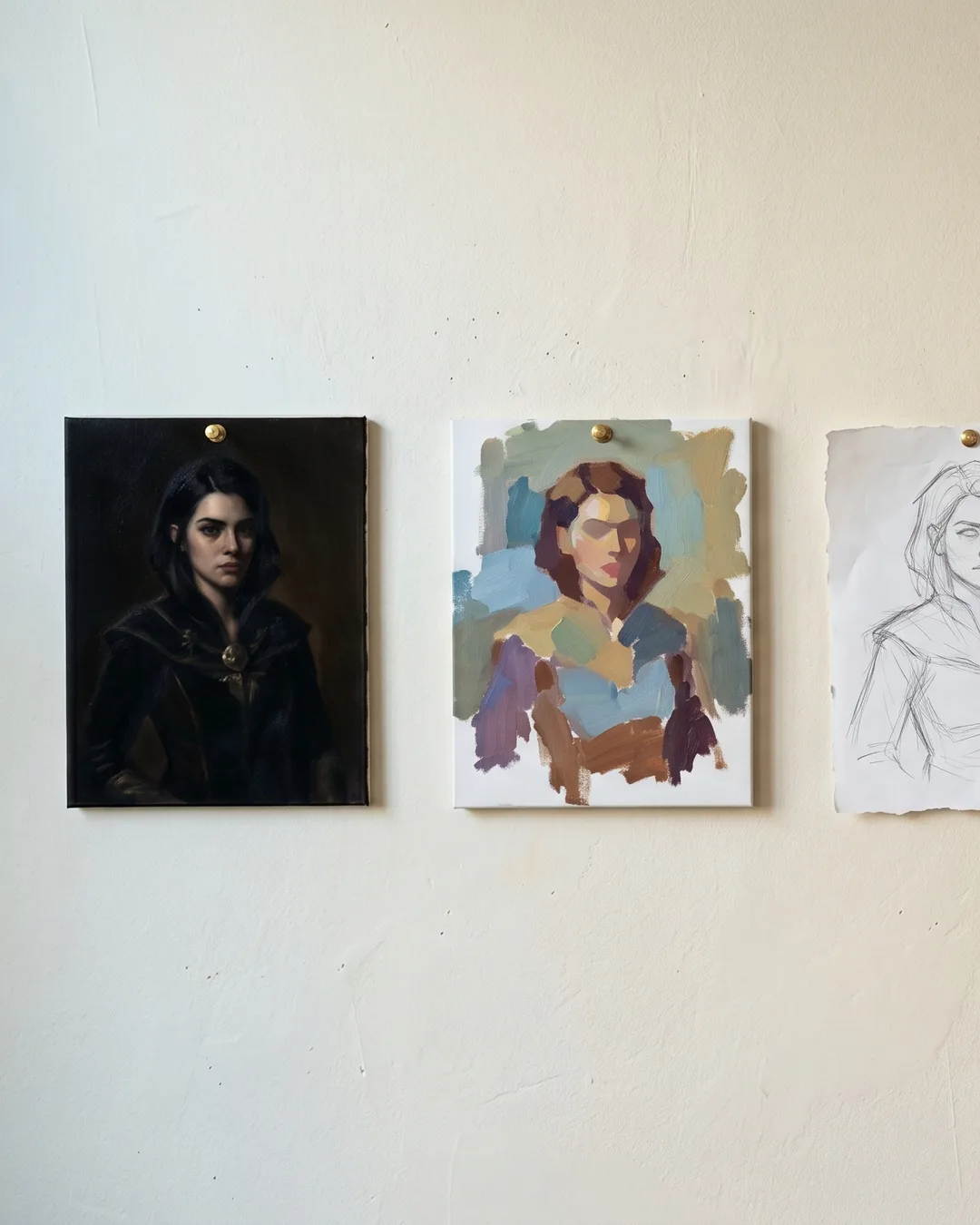
- "Can you show me a layered PSD or Procreate file from a recent commission?" A working hand-painter has these. They have line work on one layer, base color on another, shading and highlights stacked above. An AI-traced piece is a flat raster with paint on a single layer.
- "Can you send me progress shots with timestamps?" Hand-painted work goes through sketch → block → render → polish. Each stage produces a screenshot. A painter who works this way can produce 4–6 progress shots per piece. We send them automatically as part of every commission. You can see our process on the site.
- "Can you sketch in front of me on a video call before I commit?" This is the one nobody can fake. A 15-minute video call with the artist drawing the rough sketch live, in front of you, with the actual brushes they paint with, is the strongest verification possible. We offer this to every client who asks.
- "Do you have an explicit no-AI clause in your terms?" Our terms say so. So do most working hand-painters'. An AI-assisted seller usually won't put it in writing because they don't want to lie in a contract.
- "Can you take my character and paint a turnaround — front, side, and back — keeping every detail consistent?" This is a stress test. AI cannot keep a specific character consistent across three angles. A working hand-painter can.
If an artist will not answer these questions, will not show a layered file, will not get on a video call — that's the answer. Move on. There are working painters who will do all of these things. We're one of them; start a brief here if you want to test us on it.
The actual cost difference
Here are honest numbers across the three categories. We're including ours and we're not the cheapest. We don't claim to be.
AI-generated. $0 if you use a free tier with watermarks and queue limits. $10–30/month for Midjourney, DALL-E via ChatGPT Plus, or a similar paid plan. $60+/year if you're using it regularly. Per-image cost trends toward zero. What you get: a generation, no usage rights guarantee, no human authorship, no consistency across pieces, no ability to come back to the same character.
AI-traced or AI-assisted "commission." $20–80 on Fiverr, $30–100 on Etsy, $40–150 on Discord-based servers. The price reflects the paintover time, not painting time. The seller might spend 1–3 hours per piece cleaning a base. What you get: a polished surface, sometimes-decent hands, an "exclusive" file that may or may not be exclusive (the underlying generation isn't), gray-zone copyright status, no internal consistency guarantee, no ability to commission a second piece in the same style with the same character details.
Fully hand-painted commission, at our studio. $60 (bust starter, head and shoulders, simple background) to $900+ (full-action scene, environment, multiple characters). Mid-tier portraits — the size most clients want — land between $180 and $450. Turnaround is 2–4 weeks. What you get: every brush stroke painted by one painter from scratch, layered working file, timestamped progress shots, the commercial rights tier you pay for, the ability to commission additional pieces of the same character that match, a layered PSD on request, and a piece that prints and frames at 16x24 inches without falling apart.
We are the option that paints from scratch, gives you commercial rights, and signs the work. We are not the option that is fastest or cheapest.
Our pricing page shows every tier with example pieces from each. The character work page walks through which tier fits which use case. We're transparent because the comparison only makes sense if the numbers are visible.
When each option makes sense
Not every D&D portrait is the same job. Here's the decision matrix in plain language.
"I just want to see what my character could look like, for fun. It's not going on a wall." → Use AI. Generate, screenshot, share with the table. A $0–10/month subscription does this fine. Don't pay anyone for what a free generator gives you.
"I want a polished portrait on a tight budget for my Discord pfp or a token. I don't mind if some AI assistance is involved, as long as it's disclosed." → Reputable AI-traced commission, with disclosure. Look for sellers who explicitly say they use AI as a base. $20–80 is the right price band. Don't pay $100+ for something that started in a generator.
"This character means something to me. It's a gift. I want it framed on the wall. I want commercial rights. I want it to be specifically my character — the exact scar, the exact eye color, the exact armor my player described — and not an averaged version. I want to be able to come back in two years and commission the same character in a different pose and have it match." → Hand-painted commission. We do this. Most working hand-painters in the D&D space do this. The price is higher because the time investment is real and the product is different.
Match the option to the use case. The wrong tool isn't a bad tool — it's the wrong tool. Cheapest is right for the disposable job. Specific is right for the meaningful one.
If you're not sure which category your project belongs to, the question to ask yourself is: will I still care about this image in five years? If the answer is no, use AI. If the answer is yes, commission someone hand-painted.
Closing thesis
The choice you make on a D&D portrait is small. The piece is small. The price is small relative to most decisions. But the choice has weight beyond the picture itself.
When you commission a hand-painted portrait you are paying a working painter to spend 8 to 30 hours making decisions about your character. You are giving them rent. You are buying their continued ability to do this for a living. The studio model of one painter working on a manageable queue of clients — what we do, what most hand-painters in this space do — only exists if people choose to commission it. AI doesn't have that pressure. Sellers using AI as a base don't have that pressure. The only thing keeping working painters working is clients choosing them over the alternatives.
You also walk away with something specific. Clients tell us the same things in different words. "You painted her exactly the way I see her in my head." "My dad cried when he opened it." "I keep it on the wall next to my desk. I look at her every day." These are not things people say about an averaged face from a generator. They are things people say about a portrait of a specific character that a specific person painted for them.
That's the product. That's what's different. The price difference reflects what's actually in the box.
If you want a hand-painted portrait, here's where to start.
Ready to commission a hand-painted portrait?
If you've read this far, you probably know which of the three categories you want. If it's the third one, we're set up to take you through it.
See the work at full resolution. Our portfolio shows every commission we've published — D&D characters, sci-fi pilots, Western gunslingers, magic-item illustrations, the full range. Zoom in. Look at the hands. Look at the eyes. Compare what you see to the red-flag checklist above.
See the real numbers. Every tier we offer, with example pieces from each. No hidden fees. No quote-on-request gates.
Start a brief. Tell us about the character — class, race, the moment you want captured, any specific features that matter. We respond within 48 hours with a tier recommendation and a queue slot estimate. If you want to test our process before committing, we can get on a video call and sketch your character live; just ask in the brief.
We've delivered 200+ commissions since 2024. Hector G. paints every piece. No AI, ever — guaranteed in writing in our terms. If you want a portrait of your character, not an averaged version of someone like them, you're in the right place.